
KV Tiles

Custom Ceramic Tile, Made by Hand in Connecticut

KV Tiles is the studio practice of Katherine Verdickt, a Connecticut-based artist who creates custom ceramic tile installations for residential and commercial spaces. Her work sits at the intersection of painting, sculpture, and historic craft, producing handmade ceramic tile that is designed for a specific place and no other.

Every Installation Begins with a Conversation

Every project starts with a conversation between the artist, the client, and often an interior designer,  architect or museum. The goal is to understand what a space is asking for, and what the people who live in it want to carry with them. Inspiration comes from many directions: the character of a home, the surrounding landscape, a family’s history, a region’s flora. Projects can range from a singular tile to an entire space. A fireplace surround might reference the native plants of a particular valley. A fireplace surround might reference the native plants of a particular valley. In a kitchen, a backsplash might tell a story that matters to the people cooking there. A staircase mural might echo the architectural history of the building it inhabits.
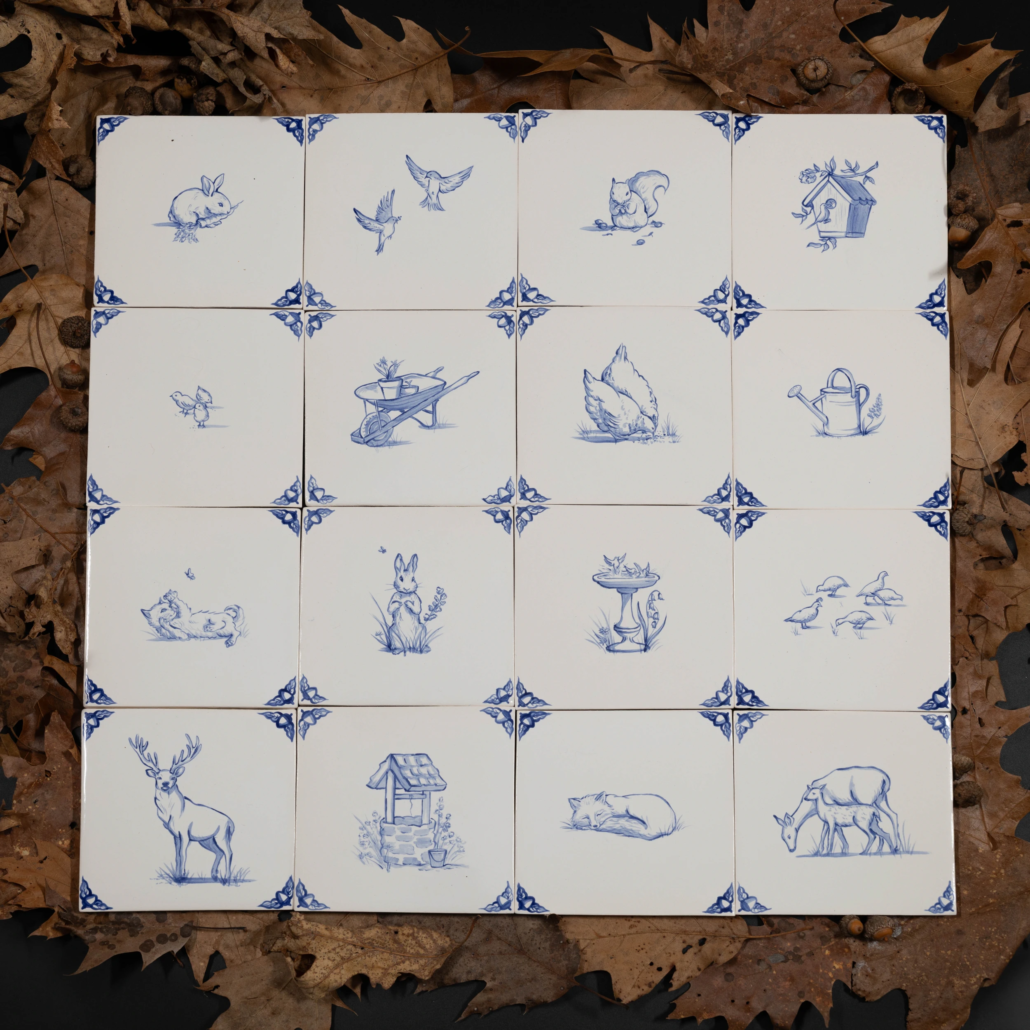
Rooted in the Delft Tradition, Open to Many Directions

The studio’s roots are in the Delft Tile tradition, one of the most recognized and enduring forms of hand painted tile in Western decorative history. That foundation informs the technical approach, but the range of work has grown well beyond its inception. Current commissions include contemporary compositions, historically informed period designs, and Moorish-inspired geometric work. What stays consistent is the process: each tile is formed, glazed, painted, and fired by hand in the New England studio.

What Handmade Actually Means

That process matters because it produces something a manufactured tile cannot replicate. Handmade ceramic tile carries subtle variation in surface, color, and texture. No two tiles come out of the kiln identical, and we consider that an essential characteristic of the work. Installed together, they create a surface that reads as alive, one that holds both the character of the clay and the mark of the artist’s hand.

These tiles are intended as permanent architectural fixtures, designed to be preserved for generations.

Services

Artistry

Every tile is drawn, painted, and finished by hand in our Connecticut studio.

Storytelling

Every commission reflects the people, places, and histories that make it unique.

Customization

Each installation is designed specifically for the client, architecture, and setting.

Heritage

Inspired by centuries of decorative arts traditions and built to last for generations.

The Process

From Materials to Art

Whether the project requires historic recreation, a custom architectural fit, or a specific surface quality, the materials themselves help determine the final aesthetic. We work with proprietary clay bodies, each chosen for a specific outcome: a crackle surface, an antique appearance, frost resistance for exterior use, or water-safe formulations for wet environments. From there, we present samples from our in-house glaze library: warm whites and cool whites alongside blues, greens, and browns, each formulated from historic recipes drawn from azulejo tradition and antique Dutch tilework. Color matching is also available. For custom installations, we work from architectural plans to produce tiles sized to the space. When historic accuracy is the priority, we use our standard 13cm format.

Preparing the Clay

As sketches are reviewed and approved, we prepare the clay. Slabs are formed by hand rolling or machine extruding, then left to dry to leather hard before being cut to size. Edges are smoothed by hand, and each tile is stamped with the studio’s maker’s mark before being stacked and weighted flat. After approximately one week, the tiles are fully dry and ready for the bisque firing.

Glazing and Firing

Glazing is done entirely by hand. We dip each tile in a unique batch of glaze. The artists paint each tile individually, following the approved prototype, and finally glaze fire to a minimum of 2,000 degrees Fahrenheit.

Ceramics is an unpredictable medium. Clay can crack or warp; glaze can develop imperfections despite consistent conditions. We use modern tools, including a slab extruder, humidity gauge, and electric kiln, but machinery has no place in the cutting or painting. From start to finish, a single tile can take several hours to complete. When one comes out perfectly, it carries the full weight of that process.

Get in touch

Web Design by Camarda Visual Studio - Legal Informations